
Categories
Reserve Bank lifts interest rates by another 0.25pc to 4.35pc
The Reserve Bank of Australia (RBA) has increased interest rates by 0.25 percentage points.
The new cash rate target is 4.35 percent, up from 4.1 percent.
Interest rates have now returned to the level they were in February 2025 before the RBA began its rate cutting cycle last year, so last year’s policy easing has been fully unwound.
The decision made on 5 May 2026 follows the previous week’s news that headline inflation accelerated sharply in March as surging automotive fuel prices (+32.8 percent in March), sparked by the war in the Middle East, pushed much higher inflation into Australia’s economy.
The RBA has now lifted rates three times this year (in February, March and May) but RBA governor, Michele Bullock said the rate rises would not stop higher inflation heading Australia’s way from the war.
She said Australia was “staring down the barrel” of a very rough time in coming months as inflation rose, the economy slowed and unemployment slowly picked up.
“These interest rate rises are not going to do anything for inflation in the next six months. That’s done and dusted”, Ms Bullock warned.
The 5 May rate rise comes a week before the Albanese government delivers its federal budget on 12 May.
Financial markets had priced in a roughly 80 percent chance of the RBA lifting rates.
The policy decision was made by majority: eight members voted to increase the cash rate target by 25 basis points to 4.35 percent and one member voted to leave the cash rate target unchanged at 4.10 percent.
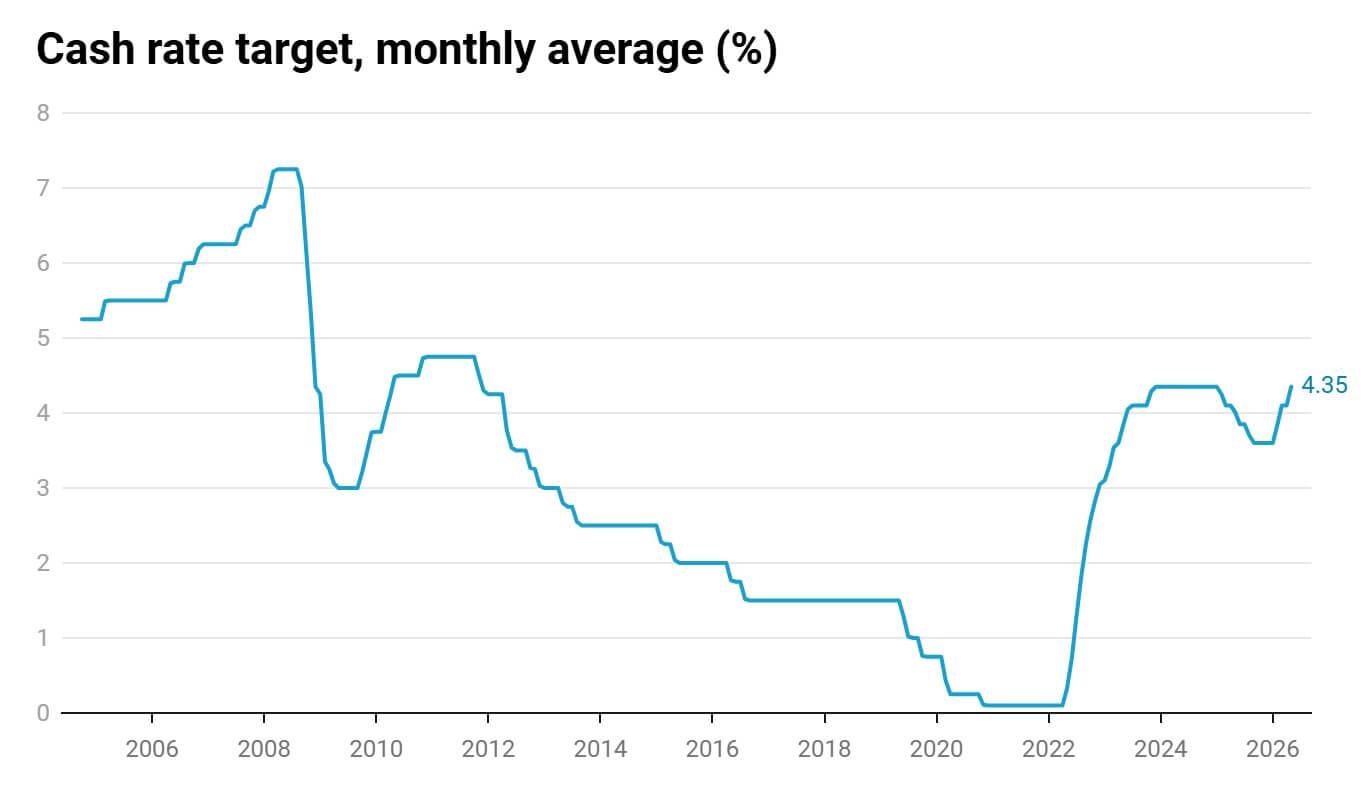
Source: Reserve Bank of Australia
Why lift interest rates?
The war in the Middle East has caused the biggest global energy shock since the 1970s, with the price of crude oil surging to more than $US120 a barrel in recent weeks.
As a consequence, rising fuel prices have begun to push headline inflation sharply higher in Australia; and those higher cost pressures will seep into every expenditure class in the Consumer Price Index (CPI) and push underlying inflation higher in the coming months too.
But economists say the RBA was already concerned about inflation before the war erupted in February.
They said this rate hike was necessary for the RBA to demonstrate its commitment to bringing inflation back down because inflation was already sitting above the RBA’s target range of 2 to 3 percent before the war broke out.
“All groups CPI” refers to headline inflation. The “trimmed mean” is the RBA’s preferred measure of underlying inflation. Annual movements prior to April 2025 are calculated by comparing each quarter to the same quarter in the previous year. From April 2025 these movements are calculated by comparing each month to the same month in the previous year.
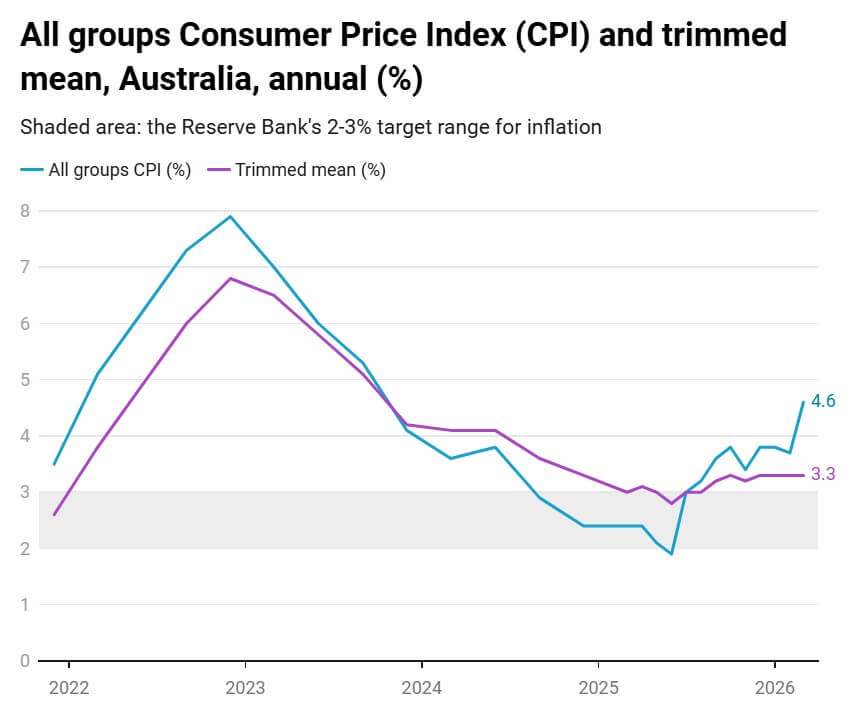
Source: Australian Bureau of Statistics
Earlier this week, former senior RBA official Jonathan Kearns, who left the bank three years ago to become chief economist at funds manager Challenger, said the RBA should lift rates to reduce the risk of stagflation.
Stagflation is a situation where economic activity is stagnating and inflation is high and rising and damaging feedback loops develop between high inflation, poor growth and employer and worker psychology.
“The term is usually applied to the 1970s when Australia and other rich countries had inflation frequently exceeding 10 percent, combined with anaemic economic growth”, Dr Kearns wrote.
“On that basis, inflation of 4.6 percent is well short of stagflation territory. But it is still too high for comfort.
“We may not have stagflation yet and the risk may be small given our economy is less dependent on oil today.
“But the risk is real. A further cash rate rise that credibly brings inflation to target is the surest way the Reserve Bank can stop today’s discomfort becoming tomorrow’s trap”, he wrote.
Economists have also been pointing to the recent collapse in business and consumer confidence in Australia.
The latest NAB business survey found that business confidence suffered its second largest monthly decline in the survey’s history in March, in an “ominous sign” for business activity in the coming months.
Economists say it is extremely important to keep a handle on inflation in this environment to try to support business confidence.
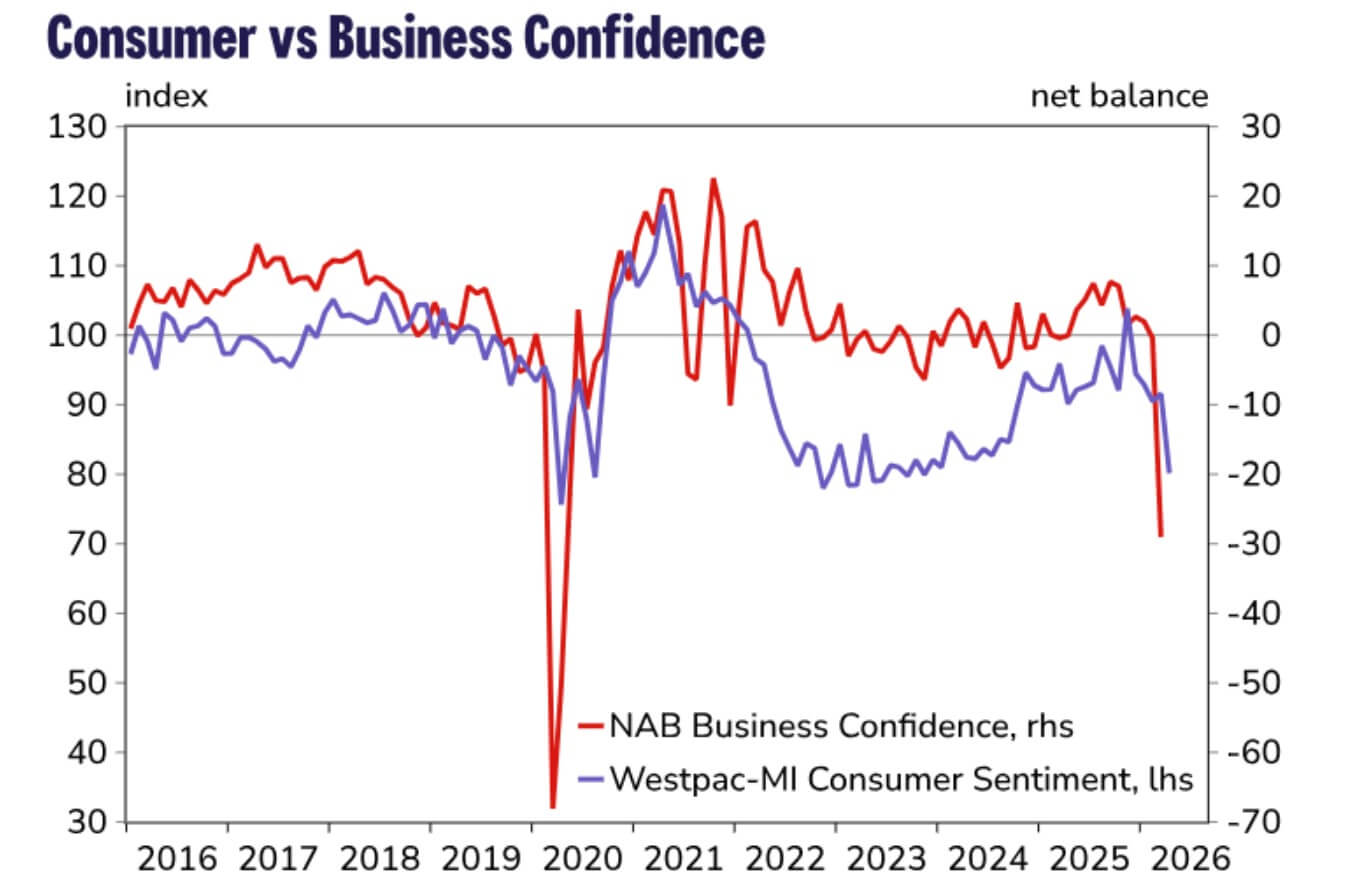
Source: NAB, Melbourne Institute of Applied Economics & Social Research, Macrobond, Westpac Economics
Last week, Deutsche Bank chief economist, Phil O’Donaghoe said the RBA could only use interest rates to manage demand and it would make little difference to the trajectory for inflation over the coming months if the cash rate were 4.35 percent or 10 percent.
“[But] the best the RBA can do is demonstrate to price and wage setters its commitment to the inflation target by taking rates back to the post COVID peak of 4.35 percent”, he wrote.
He said if the RBA did lift rates, he thought it would be the last rate rise for 2026.
RBA forecasting slower growth, rising inflation and unemployment
The RBA has published updated forecasts in its quarterly Statement on Monetary Policy (SOMP).
It is now officially forecasting headline inflation to peak at 4.8 percent in the middle of this year (it is now 4.6 percent), with underlying “trimmed mean” inflation peaking at 3.8 percent in the middle of this year (up from 3.3 percent).
It is forecasting the annual rate of economic growth to halve from 2.6 percent currently to 1.3 percent by the end of this year.
And it expects the unemployment rate to rise over the next two years from 4.3 percent to 4.7 percent.
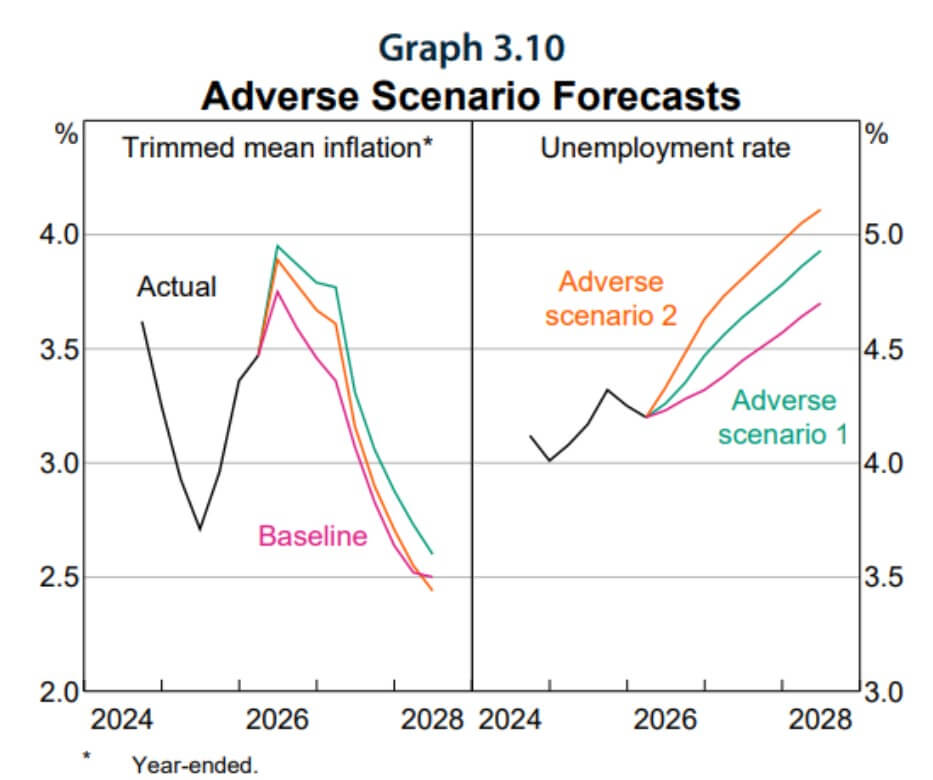
But it has also modelled two adverse scenarios that could potentially occur in Australia’s economy if the Middle East conflict is longer lasting, including an extended closure of the Strait of Hormuz and even worse damage occurs to energy infrastructure and production in the Middle East.
In both scenarios, the RBA assumes energy prices will rise very sharply in the near term and remain elevated over the forecast period.
But the two scenarios are differentiated by the degree to which total (aggregate) demand in Australia is affected by a more protracted conflict.
Inflation and unemployment get increasingly worse in Australia as the war drags on.
Sources: ABS, RBA
RBA governor warns of tough times ahead as incomes take a hit
In her press conference after the RBA Board meeting 5 May 2026, Ms Bullock said the global energy shock had already hit the real incomes of Australians and people were feeling poorer for it.
She said people would probably start asking for pay rises to deal with higher inflation and the RBA would have to manage whatever happened.
“I fully expect that people will try to make up their real wages, the hit they’ve taken from inflation, by asking for higher wages”, she said.
“The extent to which they can achieve them depends on the tightness of the labour market, so it depends on how much bargaining power they have and … there probably will be some success there.
“But what I don’t want is for [higher inflation] to become ingrained in expectations going forward”.
Source: ABC